automated crypto trading journal
The Ultimate Guide to Automated Crypto Trading Journals in 2026
Discover the best automated crypto trading journal for 2026. Eliminate manual entry, analyze performance, and find hidden profit patterns to trade like a pro.
June 20, 2026 · 14 min read
Manual data entry is the silent killer of trading performance. In a 2026 market where automated bots account for 65% of all global volume, relying on manual spreadsheets is like bringing a knife to a laser fight. You're likely spending five or more hours a week logging trades only to repeat the same emotional mistakes. It's frustrating to watch your profits evaporate because of a hidden pattern you didn't even know existed.
You deserve a clearer path to mastery. By switching to an automated crypto trading journal, you can eliminate the administrative grind and let data-driven clarity take over. This guide explores how to transform raw exchange data into a diagnostic Trading Health Score. We'll show you how to identify your most profitable patterns, reduce drawdown, and finally trade with the steady assurance of a professional. It's time to stop guessing and start optimizing.
Key Takeaways
- Eliminate the friction of manual entry by leveraging an automated crypto trading journal that syncs directly with exchange APIs for real-time accuracy.
- Gain a "Total Truth" view of your performance by aggregating data across multiple platforms into one centralized, high-tech dashboard.
- Use the Trading Health Score to move beyond surface-level metrics and gain a diagnostic understanding of your account’s objective performance.
- Pinpoint and neutralize your top three "Profit Killers" through automated pattern analysis to significantly reduce drawdown and improve consistency.
- Streamline your workflow to save five or more hours of administrative work each week, allowing you to focus entirely on execution and growth.
Table of Contents
What is an Automated Crypto Trading Journal?
In 2026, the crypto market moves at a pace that renders traditional record-keeping obsolete. An automated crypto trading journal is a specialized software system designed to sync directly with your exchange APIs. It transforms raw trade data into actionable intelligence without you lifting a finger. This isn't just a digital notebook. It's a sophisticated diagnostic tool that bridges the gap between raw execution and professional refinement. While an Automated trading system might handle the execution of your strategy, the automated journal acts as the analytical brain that reviews every move for efficiency.
We've witnessed a massive shift from "static logs" to "dynamic analytics." Old-school journaling was a post-mortem exercise; you'd look at your trades days or weeks after the fact. Modern automation provides a real-time feedback loop. It removes the "selective memory" that plagues even the most disciplined traders. Humans naturally want to ignore the trades that hurt, but automation is indifferent. It records every tick, every slip, and every win with cold, hard objectivity. This transparency is the only way to find your true Trading Health Score.
The Death of the Manual Trading Spreadsheet
Spreadsheets are where good data goes to die. Manual entry is the primary cause of "data fatigue," a condition where traders spend more time typing than analyzing. It's common to start a journal with high hopes, only to abandon it within three weeks because the administrative burden is too high. Beyond the effort, manual logs suffer from "omission bias." You're far more likely to "forget" to log a revenge trade that wiped out your morning gains than a clean winner. In a market where volatility is the only constant, manual logging is a bottleneck. It's simply impossible to keep up with high-frequency moves using a mouse and a keyboard.
The Tech Behind the Journal: API Syncing Explained
Security is the foundation of this technology. Modern journals use read-only API permissions, ensuring the software can see your data but can't move your funds. It's absolute security with zero friction. This real-time synchronization captures exact entry and exit timestamps, often with sub-second accuracy. This precision is vital. It allows you to see the exact market conditions at the moment of execution, including slippage and liquidity depth. By connecting your accounts via API, you create a "Total Truth" view of your performance across Binance, Bybit, and Coinbase simultaneously. It's about moving from confusion to a state of total data-driven clarity.
Why Automation is Your Unfair Advantage in Crypto
In the 24/7 crypto cycle, speed is more than a convenience; it's a survival trait. An automated crypto trading journal provides insights minutes after a trade closes. You don't have to wait until the end of the week to realize a strategy is failing. You see the damage or the success in real-time. This immediacy allows for rapid course correction. It turns a reactive process into a proactive strategy.
Most traders use multiple platforms to find liquidity. You might have spot positions on Coinbase, perps on Bybit, and high-leverage plays on Binance. Trying to calculate your total exposure and performance manually is a recipe for disaster. Automation aggregates these streams into a single source of truth. It visualizes your equity curves and drawdowns instantly. No manual math. No errors. Just clarity. If you're ready to stop guessing and start scaling, using a tool like Insyte's Account Performance Reports can reveal these hidden leaks in minutes.
Reviewing trades is often a painful, emotional hurdle. We naturally hate looking at losses, which leads to "forgetting" to log them. Automation removes this friction entirely. It presents data as a set of objective performance metrics. You stop seeing a "bad trade" and start seeing a "data point." This shift in perspective is what separates professional traders from the rest of the pack.
Identifying Your "Edge" Through Data
Your "edge" is often invisible in a standard exchange history. Exchanges show you price and volume, but they don't show you the statistical validity of your setups. A trading edge is the statistical probability of one outcome over another. By using an automated crypto trading journal, you can calculate your true Profit Factor across hundreds of trades. It reveals if your strategy actually has a positive expectancy or if you're just riding a temporary market trend. It provides the proof you need to size up with confidence.
Sharpening Execution with Pattern Recognition
Automation excels at finding what the human eye misses. It identifies specific patterns in your behavior that lead to losses. Maybe you're highly profitable on Tuesday mornings but lose consistently on Friday afternoons. Perhaps you have a "ticker bias" where you keep trying to trade a specific coin that never pays off. Automated journals help you spot the difference between "lucky wins" and "strategic wins" by analyzing your risk-to-reward execution. When you know exactly which coins to avoid and which times to stay flat, your profitability increases by default.
Key Metrics Your Automated Journal Must Track
Most traders obsess over P&L as their primary metric. It's a shallow way to view performance. A professional automated crypto trading journal tracks the relationship between your Win Rate and your Risk/Reward ratio. These two numbers are the heartbeat of your strategy. A 70% win rate is meaningless if your average loss is triple your average gain. You're just one bad day away from a total account wipeout. The goal is to find a sustainable balance where your edge produces consistent growth without requiring a perfect record. Data removes the guesswork and shows you exactly where your math is failing.
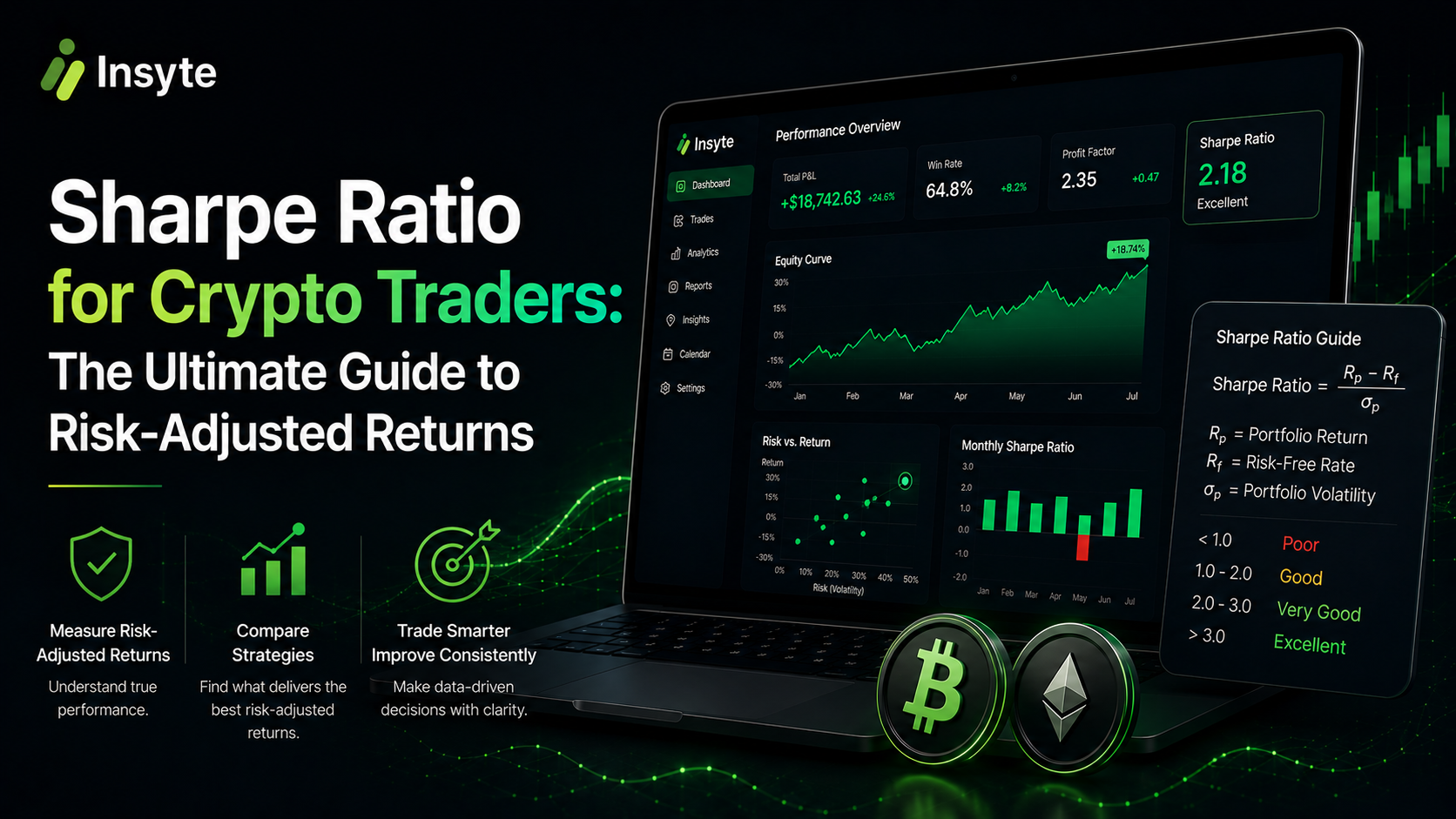
Drawdown analysis is equally critical for long-term survival. It isn't just about how much you lost in a single trade. It's about understanding the depth and duration of your losing streaks. Knowing that your strategy typically recovers from a 10% drawdown within four days gives you the psychological fortitude to stay the course. Professional traders also focus on the Profit Factor and Sharpe Ratio. These metrics normalize your returns against the risk you're taking. They tell you if you're actually a skilled trader or if you're just taking massive, uncalculated risks in a trending market.
The Trading Health Score: Beyond the Equity Curve
The Trading Health Score is a proprietary diagnostic that offers a holistic view of your account status. It's a composite metric that measures both your discipline and your strategy's effectiveness. You can have a high win rate but a dangerously low Health Score if you're constantly moving stop losses or over-leveraging your positions. It acts as an early warning system. When your score drops, it's a signal to scale down and re-evaluate. When it's high, you have the data-backed confidence to increase your position sizes and push your advantage.
Ticker and Symbol Analytics
Performance is rarely uniform across all assets. Using a Ticker Analyzer helps you identify your "Goldmine" assets. Many traders discover they lose 80% of their profits on a single specific coin while performing exceptionally well on others. By filtering your performance by asset class, such as L1s, Memecoins, or DeFi, you can see where your true expertise lies. Stop trading your "Profit Killers" and double down on the tickers that actually respect your setups. This level of granular insight is what transforms a struggling account into a high-performance instrument.
How to Use Your Journal to Fix Trading Leaks
Identifying a problem is only half the battle. The real value of an automated crypto trading journal lies in its ability to provide a step-by-step diagnostic for your performance. You can't fix what you don't measure. By following a structured review process, you move from reactive guessing to proactive optimization. It's about finding the specific "leaks" in your boat and plugging them before they sink your account. This is where you transition from a participant to a professional.
The process starts with aggregation. Sync all your accounts to get a "Total Truth" view of your performance. Once your data is centralized, you can use Account Pattern Analysis to identify your top three "Profit Killers." These are the recurring behaviors, such as late entries or revenge trading, that consistently drain your capital. Next, analyze your hold times. Many traders find they're cutting winners too early out of fear, leaving significant ROI on the table. By reviewing your Trading Health Score, you can pinpoint periods of emotional overtrading where your discipline faltered. Finally, adjust your strategy based on objective data rather than gut feeling. Gut feeling is a luxury that professional traders simply can't afford.
Spotting and Stopping Overtrading
Overtrading is the most common cause of account decay. Automated journals flag excessive trade frequency by highlighting spikes in your activity that don't align with your strategy. There's often a direct, negative correlation between high trade volume and declining win rates. When you trade too much, your focus dilutes and your execution suffers. Use your performance reports to set data-driven limits for your daily trade count. If your win rate drops significantly after three trades, stop at two. It's a simple adjustment that yields massive results.
Optimizing Hold Times for Max ROI
Capital efficiency is the key to scaling. You need to compare your profit against the time spent in each trade. If you're holding an asset for three days for a 1% gain while other assets are moving 10%, you've found "dead time." This is capital tied up without movement. Hold Time Optimization is the process of aligning trade duration with maximum volatility capture. By analyzing your exit efficiency, you can determine if you're staying in trades too long or exiting right before the peak move. Stop letting your capital sit idle and start putting it where the volatility is highest.
Setting Up Your Automated Workflow with Insyte
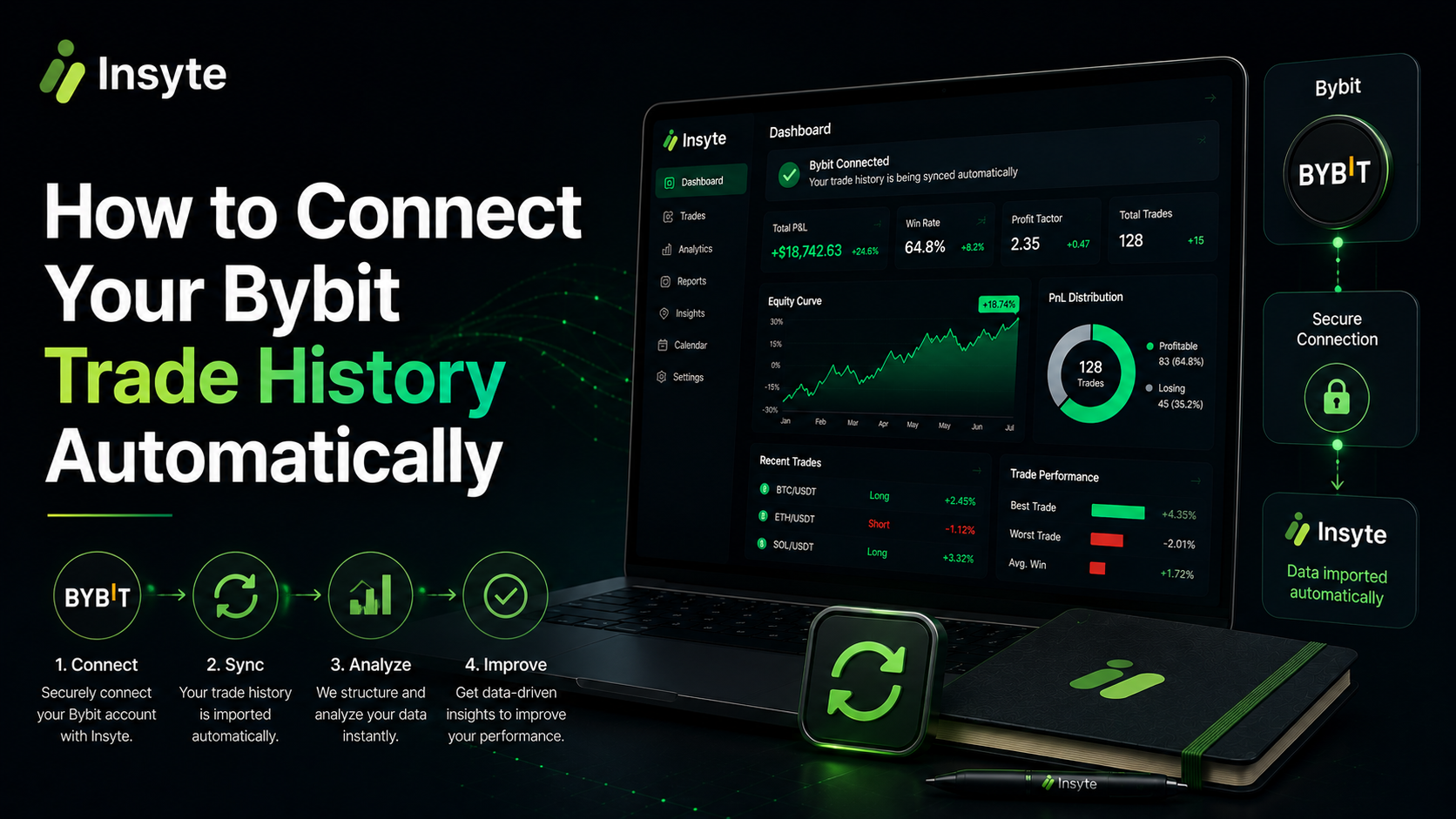
Transitioning to an automated crypto trading journal is the moment you trade a manual burden for a high-performance instrument. The setup is built for speed. You can connect your first exchange via API in under two minutes. This secure, read-only connection pulls your historical data into one sleek interface. No more fighting with broken formulas. Just immediate access to your Trading Health Score. It's a streamlined bridge from confusion to total clarity.
Insyte’s modern UI simplifies complex performance data. It doesn't just dump numbers. It organizes them into intuitive Account Performance Reports that tell a story. You'll move from hours of tedious data entry to a daily performance audit that takes five minutes. This efficiency allows you to spend your time where it matters: refining your strategy. It's a sophisticated partner for those serious about their craft. Use the Ticker Analyzer to verify your strengths and the Account Pattern Analysis to shore up your weaknesses.
From Data Points to Actionable Intelligence
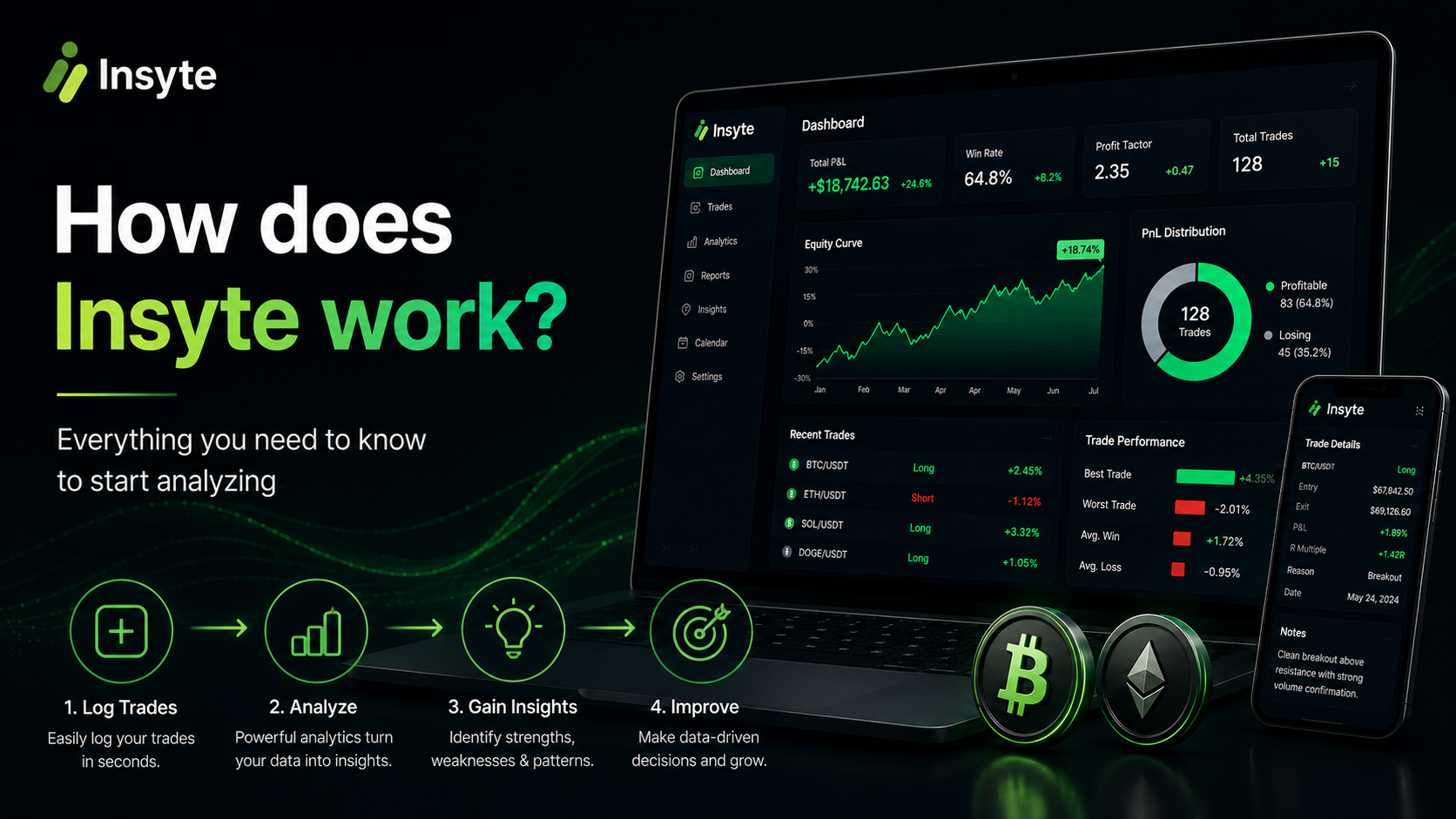
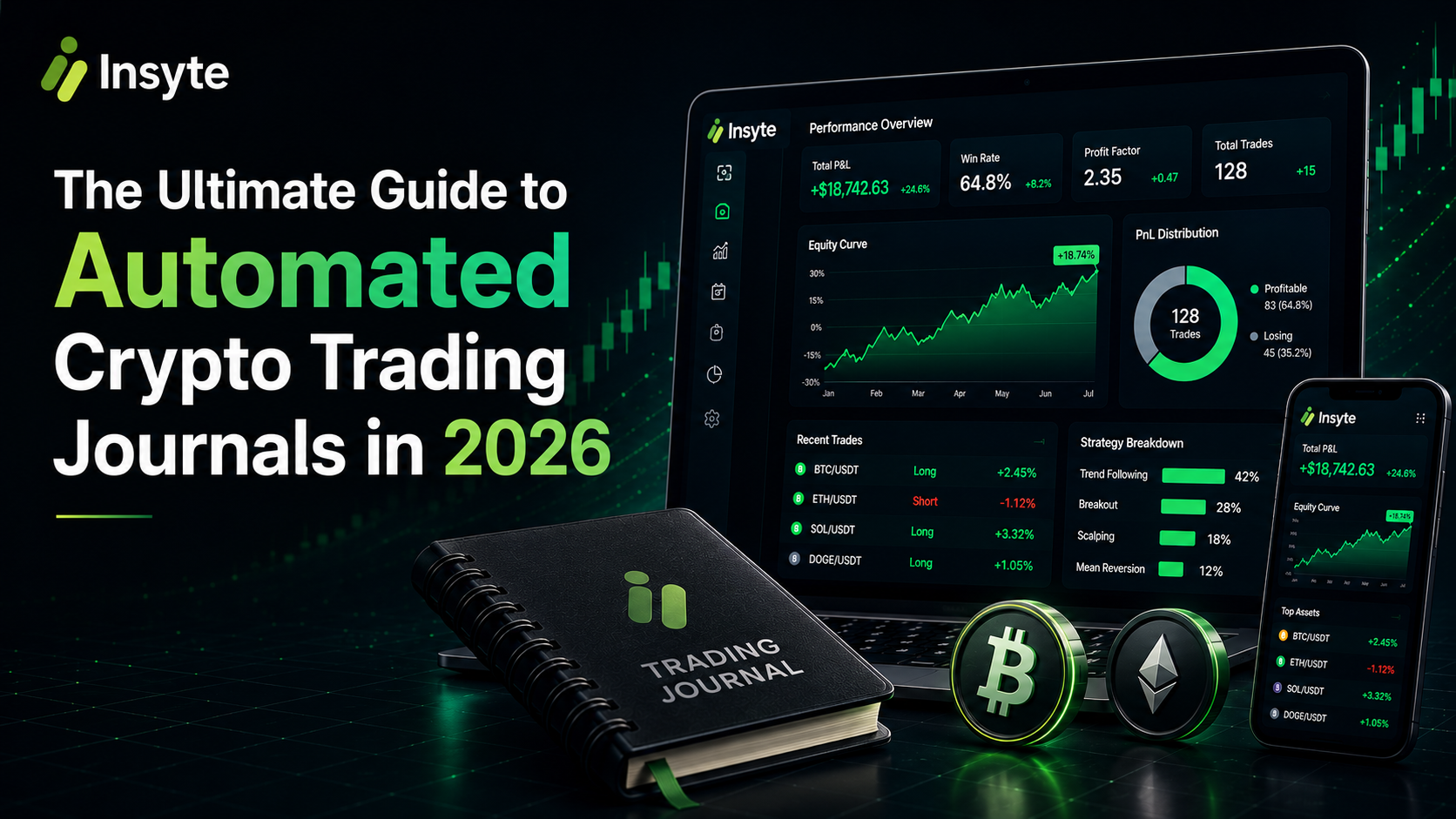
The dashboard provides instant clarity. You can see your equity curves, drawdown depth, and ticker-specific performance at a glance. There's a unique satisfaction in watching your Health Score improve as you eliminate your "Profit Killers." Professional traders don't view their journal as a chore. They view it as their Head Coach. It provides the objective feedback necessary for mastery. It keeps you accountable when the market gets loud. It's the difference between gambling and professional execution.
Join the Future of Trading Performance
The transition from confusion to understanding is the ultimate competitive advantage. By maintaining a historical data archive, you're building a foundation for future strategy backtesting. You aren't just logging trades; you're creating a library of your own professional evolution. The market will always be volatile, but your process can be steady. Stop leaving your success to chance. Stop guessing and start knowing with Insyte.
Master Your Trading Performance
The transition from manual logging to a high-performance automated crypto trading journal is more than a convenience. It's a strategic upgrade. By leveraging automated API sync for Binance, Bybit, and other major exchanges, you remove the friction of data entry and the bias of selective memory. You gain a clear, objective view of your execution. This clarity is the foundation of consistent profitability.
Mastery comes from understanding the specific reasons behind your wins and losses. With proprietary Trading Health Score analytics, you can finally move beyond surface-level P&L. You'll identify the patterns that drive your success and the leaks that drain your capital. The path to professional trading is paved with data, not guesses. It's time to refine your process and trade with the confidence of a market leader.
Start your journey to trading clarity with Insyte. Your future performance depends on the insights you capture today. Take control of your data and watch your results transform.
Frequently Asked Questions
Is an automated crypto trading journal safe to use?
Yes, it is safe as long as you use read-only API permissions. This protocol allows the software to view your trade data without the ability to withdraw funds or execute orders. It's a standard security measure that ensures your capital remains protected on the exchange while giving you total transparency into your performance metrics.
Can I connect multiple exchanges like Binance and Bybit to one journal?
Absolutely. You can aggregate data from multiple platforms like Binance, Bybit, and Coinbase into a single, high-tech dashboard. This provides a "Total Truth" view of your performance across your entire portfolio. It eliminates the need to manually consolidate spreadsheets or jump between different exchange interfaces to see your overall progress.
What is the difference between a trading journal and exchange history?
Exchange history is a raw list of transactions; an automated crypto trading journal is a diagnostic system. While an exchange tells you "what" happened, a journal explains "why" it happened. It calculates sophisticated metrics like your Trading Health Score and Profit Factor that are completely invisible in standard exchange logs.
How does an automated journal help with trading psychology?
It helps by removing emotional bias and selective memory from your review process. Automation forces you to confront every trade, including the losing ones you might naturally want to ignore. By reviewing objective Account Performance Reports, you can identify the exact behavioral patterns that lead to emotional overtrading and poor execution.
Do I need to be a professional trader to use an automated journal?
No, you don't need to be a professional to benefit from automation. Newer traders often see the fastest results because the software prevents bad habits from forming early in their careers. It acts as a supportive coach, providing the data-driven clarity needed to transition from a state of confusion to consistent, professional-grade execution.
What are the most important metrics to look at in a crypto journal?
Focus on your Trading Health Score, Risk/Reward ratio, and Profit Factor. These metrics normalize your returns against the risk you're taking, which is far more important than simple P&L. You should also use a Ticker Analyzer to see which specific assets respect your setups and which "Profit Killers" you should stop trading immediately.
How much time does it take to set up an automated trading journal?
Setting up an automated crypto trading journal takes less than two minutes. The process is streamlined for immediate impact: you simply generate a read-only API key on your exchange and paste it into the journal. Your historical data syncs instantly, allowing you to move directly from data entry to a high-level performance audit.
← Back to all posts